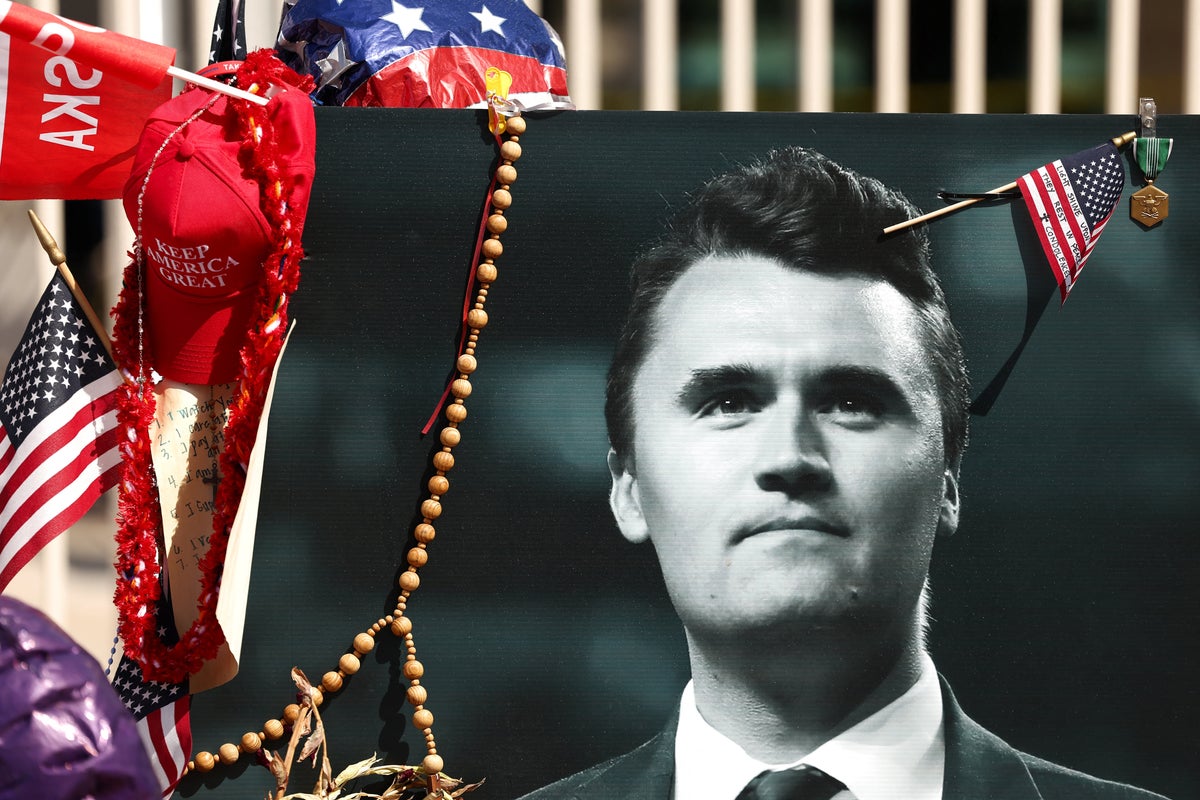
A majority of Americans believe “extreme political rhetoric” was a principal cause behind Charlie Kirk’s assassination, a new poll has revealed.
Perhaps, surprisingly, there was cross-party agreement on the matter as a majority of Republicans, Democrats and independents told NBC News in response to the survey that inflammatory language used by prominent political figures and the media was a decisive factor in the killing, rather than attributing it simply to the actions of a disturbed individual.
The Turning Point USA founder, 31, was shot dead on the campus of Utah Valley University in Orem, Utah, on September 10 while taking part in an outdoor debating session with students.
Kirk, a married father of two, was shot in the neck by an assassin’s bullet fired from a nearby rooftop and a suspect, Tyler Robinson, 22, was arrested following a manhunt.
He was subsequently charged with aggravated murder, one count of felony discharge of a firearm, two counts of obstruction of justice, two counts of witness tampering and one count of violence committed in the presence of a child. Utah state prosecutors have said they will seek the death penalty.
Overall, 61 percent of respondents to the NBC poll said they believed extreme rhetoric was to blame for the tragedy, while 28 percent said it was “caused by a disturbed person,” and just 4 percent said they felt that both factors had played a part.
Republicans apportioned the blame 73 percent to 19 percent in favor of rhetoric, Democrats put it at 54 percent to 34 percent, and independents at 53 percent to 28 percent.
NBC compared the killing with four other acts of political violence from the last 15 years – the shooting of congresswoman Gabby Giffords in January 2011 and of Steve Scalise in June 2017, the home invasion attack on Paul Pelosi in November 2022 and the second attempt on the life of President Donald Trump on a Florida golf course in September 2024 – and found an increasing willingness to identify irresponsible partisan discourse as a contributing factor.
While just 24 percent of respondents blamed rhetoric for the Giffords attack, 41 percent felt it had played a significant part in the Scalise shooting at a summer baseball practice and 49 percent said it was the primary cause of the shocking hammer attack on the ex-House speaker’s husband in San Francisco.
In the immediate aftermath of Kirk’s murder, members of the Trump administration such as Vice President JD Vance and Deputy Chief of Staff Stephen Miller made clear that it considered “left-wing extremism” to blame, pointing to the jumble of political slogans written on the casings of bullets fired at the conservative activist.
However, nothing definitive has ever been found to tie Robinson to organized left-wing political groups and the administration’s plan to launch a “war on terror” against Antifa has yet to materialize and was reportedly met with skepticism even within its own ranks.
The president did issue a national security memorandum on September 25 that accused liberals of “animating… violent conduct” and hiding a terror agenda behind “anti-fascist” positioning, calling for federal prosecutions.
Kirk, a hard-line Christian conservative, was no stranger to divisive narratives himself and was regularly accused of misogyny, homophobia and Islamophobia in response to some of his public statements, which frequently echoed Trumpian talking points.
A number of other violent incidents have taken place this year involving politicians, including an arson attack on the home of Pennsylvania Gov. Josh Shapiro in April and the murders of Minnesota’s ex-state House speaker Melissa Hortman and her husband Mark Hortman in June.
An ICE detention center in Dallas, Texas, was also targeted by a gunman less than two weeks after Kirk’s death.
