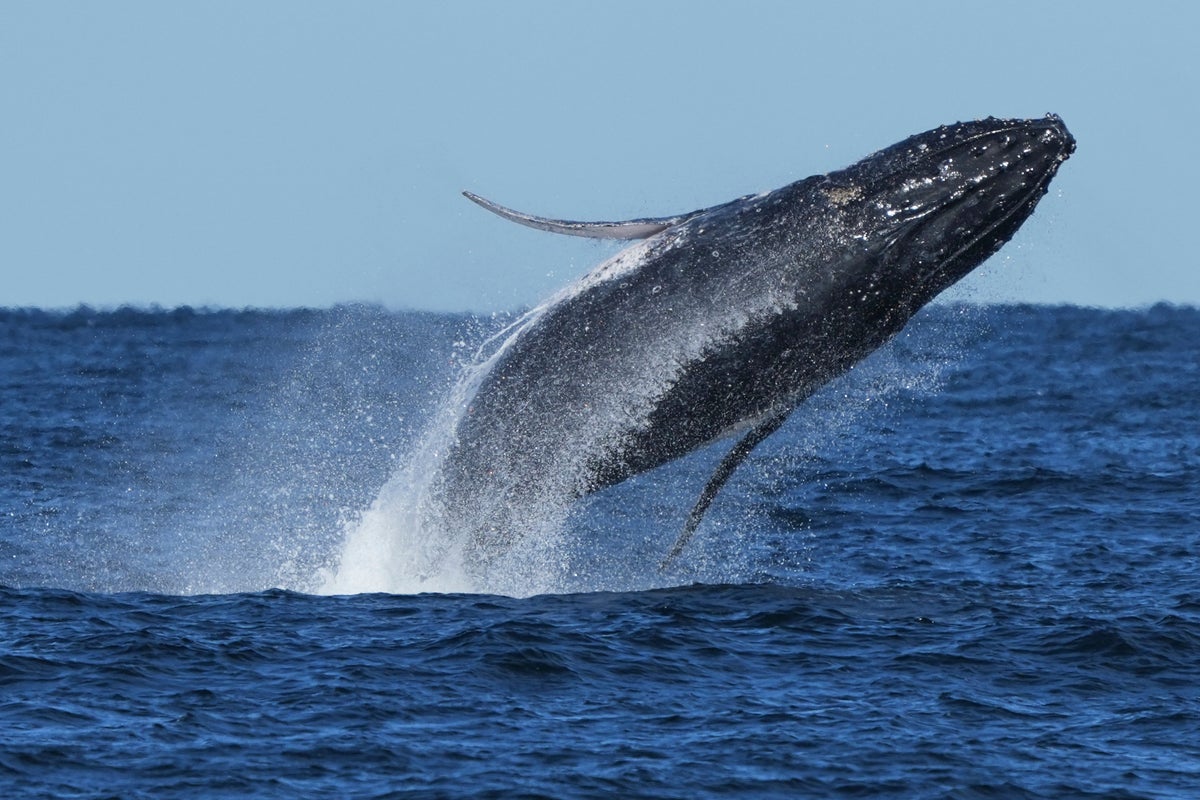
A massive humpback whale has crashed ashore on an Oregon beach after getting caught in a crab fishing gear.
The huge mammal is still alive but is in deep distress as volunteers race against time to save the 50-ton sea creature, which has become beached in San Marine. According to Oregon Live, the whale is a juvenile female, which is under three years old and is roughly 30 feet long.
Now, Carrie Newell, a marine biologist at Whale Research Eco Excursions, has called on the public to stay away to allow experts to continue their rescue efforts.
“The humpback is a wild animal and please, under no circumstances, approach the whale,” she said in a statement. “Not only is this endangering your life but it is also causing stress to the animal.
“Whales were designed to live in the water and a beached whale therefore is not bouyed up by the water so the internal organs are being compressed which is causing additional complications. This in itself can be life-threatening to the whale.”
However, despite the efforts to save the whale, experts have warned that it is unlikely that it will survive.
Lisa Ballance, from the Marine Mammal Institute at Oregon State University, told Oregon Public Broadcasting that the animal’s “prospects are slim to none.”
“It comes ashore for a reason, and the reason is that it can’t survive out at sea in the ocean,” she added. “There’s really nothing that we can do to help this individual except give it some room.”
Newell agreed with the grim outlook for the whale, but suggested that there still might be a reason to hope. She added if the whale has enough energy to push itself back into the water when the ocean is at high tide, it could still survive.
In the event of the whale’s death, Ballance told the public broadcasting channel that scientists will perform a necropsy to determine the cause of death.
That will involve experts taking samples from the animal’s carcass, which she describes as being “extremely valuable to science.”
Newell says it is the third humpback whale to wash ashore in a little over a month. The massive mammals normally head south in the winter, in search of warmer waters near Mexico and Central America, where they mate and give birth.
Currently, there are an estimated 80,000 humpback whales left in the wild, according to the Endangered Species Coalition. Although many subspecies of humpback whales are still regarded as being endangered, their numbers have rebounded from a low point of just 10,000 to 15,000.
An average adult can grow up to 52 feet in length and can weigh between 30 and 50 tons.
