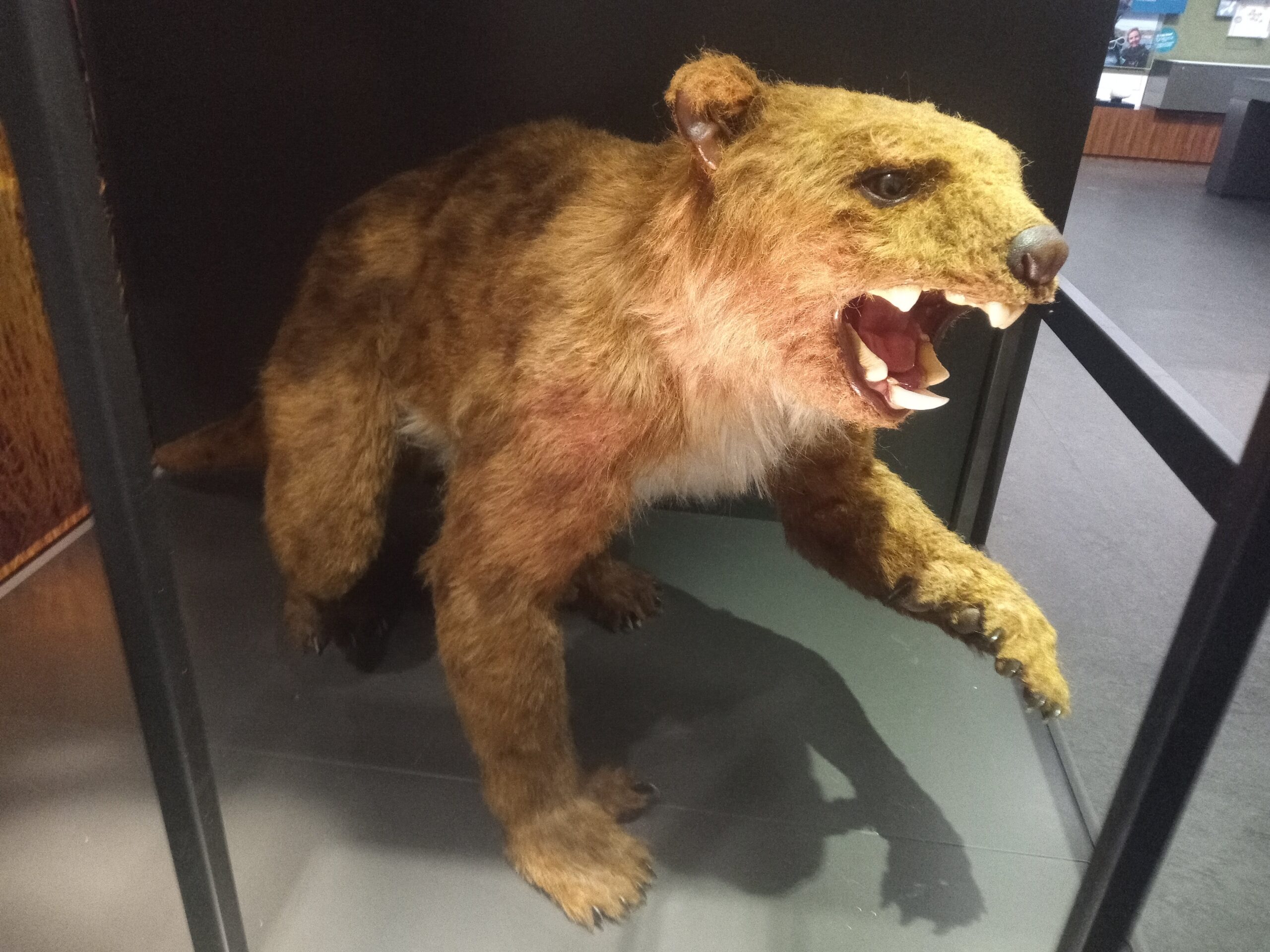
A version of the mythical Australian “drop bear”, a carnivorous marsupial resembling a koala, actually lived on the continent at least until about 40,000 years ago, scientists revealed in a new study.
The “drop bear” is a classic Aussie myth of a carnivorous version of the koala, said to live in trees and attack people by dropping onto their heads from above.
Contrary to the docile koalas, the mythical drop bears are described as unusually large and vicious marsupials in Australian folklore.
Now, researchers have found fossil evidence that a carnivorous marsupial resembling koalas did in fact live on the continent up until their extinction 40,000 years ago.
Modern-day koalas are the closest living relatives of this “marsupial lion”, or Thylacoleo carnifex, according to a new study published in the journal Proceedings of the Royal Society B.
These carnivorous marsupials thrived on the continent during the Late Pleistocene era from about 126,000 till one of the greatest waves of extinctions of large animals on the planet about 40,000 years ago.
A large proportion of the planet’s giant animals were lost during this time, with Australia losing nearly 90 per cent of its land species weighing over 44 kg by around 46,000 years ago.
This period, also coinciding with the arrival of humans to the continent, strongly affected Australia’s biodiversity and represented a major loss in evolutionary history.
However, the causes of this megaextinction remain poorly understood.
In the latest study, scientists applied a new technique which creates a unique fingerprint for species based on the collagen proteins in their fossils.
Using this method, researchers could trace the evolutionary history of three extinct Australian giant animals: Zygomaturus – a herbivore that looked like a 500kg wombat, Palorchestes – another herbivore that resembled a tapir, and Thylacoleo carnifex – the marsupial lion.
The analysis revealed that the Thylacoleo is a closer relative to the koala than to any other animal group.
“The weight of evidence provided by the collagen peptide data favoured a close relationship between Thylacoleo (the so-called ‘marsupial lion’) and the koala, as part of a broader clade including wombats,” researchers wrote.
These findings also point to the usefulness of the new technique of using collagen protein from fossil samples to construct evolutionary trees and better understand the diversity of past life on Earth, scientists say.
Researchers hope that further research using their new method can conclusively establish the cause of the mass extinction.
