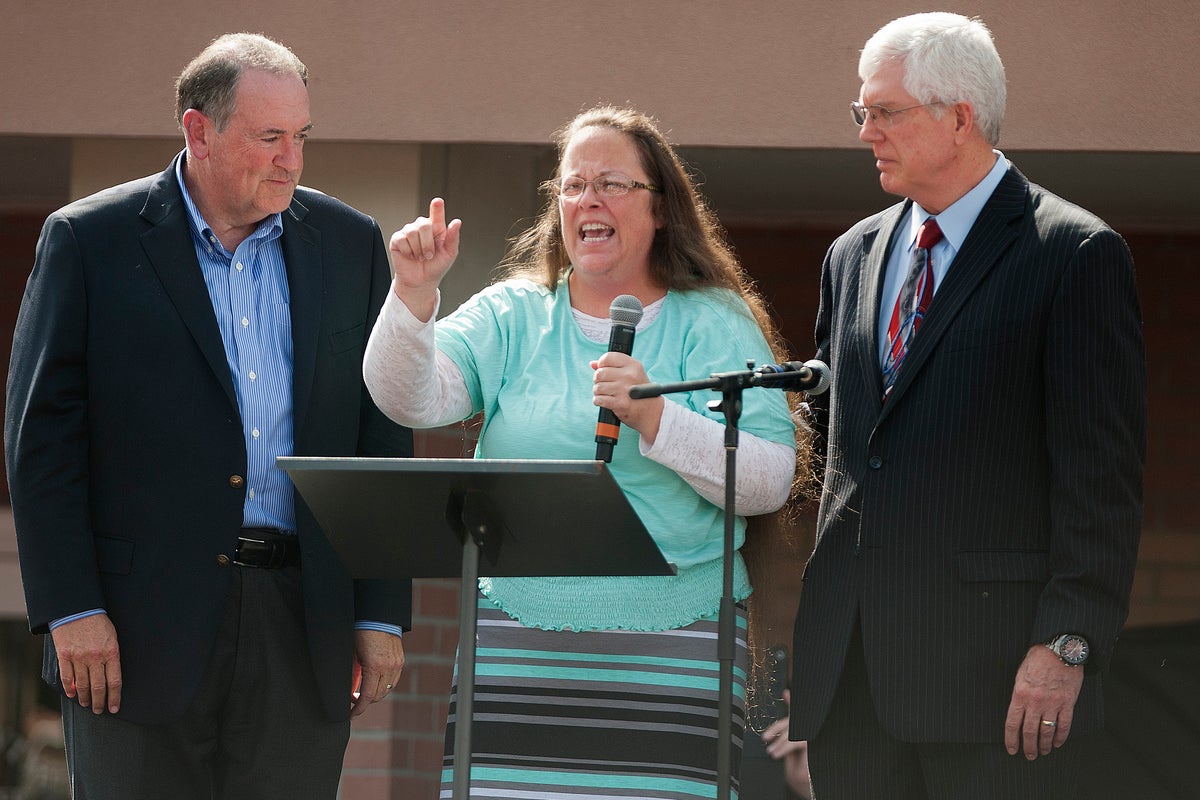
In 2015, after the Supreme Court legalized same-sex marriages nationwide, a county clerk in Kentucky famously refused to issue a marriage license to two men, launching a decade-long legal battle that has now landed at the steps of the nation’s high court.
Kim Davis still owes David Ermold and David Moore more than $300,000 after she lost a lawsuit accusing her of violating their constitutional rights for refusing to approve their marriage license. Davis appealed, claiming she was immune from personal liability as a government official, and lost.
She is now turning to the justices to bail her out — and hoping to take down the landmark decision in Obergefell v Hodges with her.
The justices will consider whether to hear her challenge in their private conference Friday, among thousands of petitions the court receives each year. Legal experts told The Independent they are deeply skeptical that her petition will go anywhere, but anxious same-sex couples and advocacy groups fear the conservative-majority court will once again open the door for debating LGBT+ rights under the guise of religious freedom.
“Obergefell is the settled law of the land, and we are hopeful the Court will deny the petition,” William Powell, senior counsel at Georgetown Law’s Institute for Constitutional Advocacy and Protection, told The Independent.
In her petition to the Supreme Court, Davis, a devout Christian, argued she had a First Amendment right as a public official to deny issuing licenses to LGBT+ couples, citing her religious beliefs.
“Obergefell v Hodges cannot override the free speech and religious exercise protections of the First Amendment,” according to Mat Staver, chair of evangelical Christian legal group Liberty Counsel, which is taking Davis’s arguments a step further in calling for the high court to overturn same-sex marriage protections entirely.
“Like the abortion decision in Roe v Wade, Obergefell was egregiously wrong from the start. This opinion has no basis in the Constitution,” according to Staver.
In her petition to the court, attorneys for Davis said Ermold and Moore cannot sue over “hurt feelings” over her “religious expression.” Without the Supreme Court’s intervention, Obergefell will remain an obstacle for “First Amendment’s protections for public officials with sincerely held religious beliefs,” they claim.
“This case provides a suitable vehicle to establish the clear guidance that lower courts and government officials currently lack,” attorneys wrote.
At least 823,000 same-sex couples are legally married in the United States, according to research from the Williams Institute at UCLA School of Law. Nearly 600,000 of those couples married in the years after Obergefell.
Those couples are also raising nearly 300,000 children under age 18, the institute found.
“For over a decade, far-right groups like the Alliance Defending Freedom and Liberty Counsel have been fighting to drag us back to a time where LGBTQ+ people did not enjoy the same freedom to marry as every other American,” Human Rights Campaign president Kelley Robinson told The Independent.
“They want us afraid,” she said. “But here are the facts: marriage equality is the law of the land, and is supported by a bipartisan, supermajority of the American public.”
Davis’s petition is among thousands that the high court receives every year, most of which are denied.
Same-sex couples who are currently married also are likely to maintain those protections under the Respect for Marriage Act, which was signed into law by President Joe Biden in 2022, ensuring that same-sex marriages performed in one state are recognized by in others as well as by the federal government. But the law does not require every state to issue marriage licenses in the unlikely event Obergefell is overturned.
“Even if the Court takes this up, this petition centers on damages owed by Kim Davis — not necessarily the broader question of marriage equality. Pro-equality Americans fought hard for the Respect for Marriage Act, which protects federal marriage rights for same-sex and interracial couples,” Robinson said.
Still, the idea of putting hard-fought protections for LGBT+ couples back on trial has frustrated and outraged advocates who fear the worst under a court that liberal Justice Sonia Sotomayor says has broken the firewall between church and state.
Jim Obergefell, the man at the center of the case that legalized same-sex marriages, is “disgusted” by what he sees as a distortion of religious liberty, he told The Advocate. “This modern version of religious freedom — this belief that one’s personal religion trumps everything else — is a twisting and perverting of what our founders intended,” he said.
The court’s decision to end a constitutional right to abortion care in 2022’s Dobbs v. Jackson Women’s Health Organization proved how fragile precedent can be, he said. “If they were willing to overturn Roe after saying it was settled law,” Obergefell said, “why on earth should I believe anything else they say?”
In his concurring opinion in Dobbs v Jackson Women’s Health Organization, Justice Clarence Thomas suggested that the court could “reconsider” major cases involving “substantive due process precedents” — including the court’s landmark cases involving same-sex marriages, gay sex, and contraception.
“Because any substantive due process decision is ‘demonstrably erroneous’ … we have a duty to ‘correct the error’ established in those precedents,” Thomas wrote. “The question would remain whether other constitutional provisions guarantee the myriad rights that our substantive due process cases have generated.”
Those cases include Griswold v Connecticut, which ruled that states had no right to ban contraception; Lawrence v Texas, which struck down laws banning same-sex sex; and Obergefell.
Lawyers for Ermold and Moore have argued in court filings that Kim Davis’s request should be an easy case for the justices to reject from the outset.
Aside from Davis’s failures to argue for First Amendment protections in this case, which were already rejected by an appeals court, “overruling Obergefell could call into question the constitutional status of existing same-sex marriages and disrupt the lives of those who aspire to, plan their affairs around, and benefit from same-sex marriage,” they wrote.
She also already waived her right to challenge the Supreme Court’s same-sex marriage protections because she “expressly stated that she did not want to relitigate the Supreme Court’s decision in Obergefell,” they argued.
“The Court should hold her to that representation,” they said.
