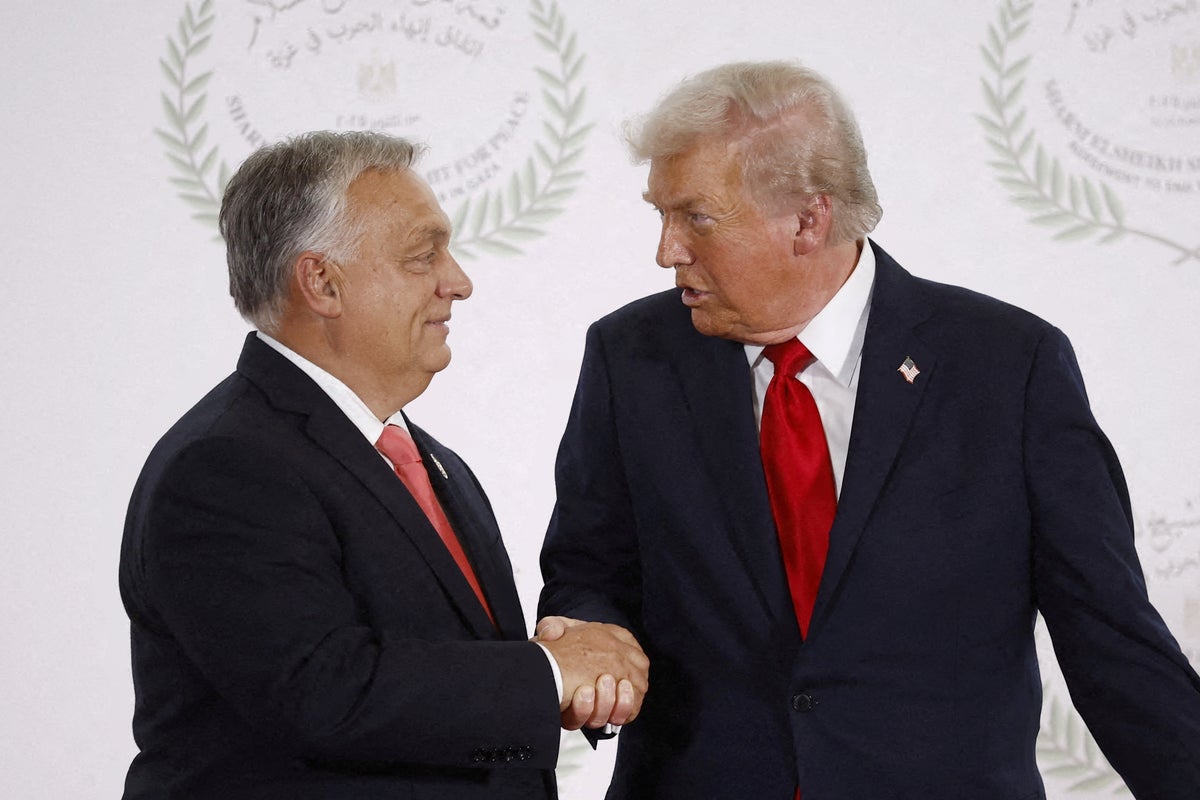
Hungary’s prime minister Viktor Orban will meet president Donald Trump at the White House on Friday to seek exemptions from US sanctions on Russian oil and broker a summit between the American leader and Russian president Vladimir Putin.
Last month, Mr Trump levied sanctions on Russian state-affiliated energy giants Lukoil and Rosneft, exposing buyers including India, China and Hungary to secondary penalties.
Mr Orban, an ally of both Mr Trump and Putin, said Hungary would seek exemptions from the decision due to its reliance on Russian oil as a landlocked country.
“All diplomatic negotiations are hard, but I expect a friendly and easy negotiation,” Mr Orban told state media ahead of the visit, which marks the first bilateral meeting between the two countries since Mr Trump’s return to the White House earlier this year. He is reported to have said that the “stakes were high” during his flight to Washington.
“I know the president, he knows me, we know the subject, we simply have to reach an agreement,” the PM said, according to MTI.
Mr Trump and Mr Orban share similar populist right-wing policies, including a hardline stance on immigration. The Hungarian PM was one of the first international leaders to publicly support Mr Trump’s first presidential bid in 2016.
With Mr Orban facing a domestic election in 2026, he will hope that the meeting will boost his standing among Hungarian voters. The PM is seeking to use his alliances to play a central role in brokering a potential ceasefire between Russia and Ukraine, to Kyiv’s dismay.
Budapest had been due to host a highly anticipated summit between Mr Trump and Putin over the war in Ukraine, but the meeting collapsed last month after a phone call between Russia’s foreign minister Sergey Lavrov and US secretary of state Marco Rubio. The Russian minister is said to have reiterated Moscow’s maximalist demands for a peace agreement, which were rebuffed by Washington.
The talks were postponed and then eventually axed, with Mr Trump saying he did not want to “waste time” meeting Putin if the two sides could not agree on the framework for a deal.
Mr Orban, once a fierce critic of Putin, has consistently opposed Ukraine’s independence and repeated Kremlin talking points on the origin of the war. In September, he baselessly claimed Ukraine “is not an independent country”, sparking outrage in Kyiv and other European capitals.
Hungary’s increasingly cosy relationship with Putin and subsequent reliance on Russian oil is one that could be crucial to its economic survival.
In 2024, the country received 80 per cent of its oil (5 million tonnes a year) through the Friendship pipeline from Russia, via Belarus and Ukraine.
“We have to make the Americans understand this strange situation if we want exceptions to the American sanctions that are hitting Russia,” Mr Orban said last month.
Mr Trump told reporters in response: “The president – he has asked for an exemption. We haven’t granted one, but he has asked. He’s a friend of mine.”
The US president imposed sanctions on Russian oil in an attempt to drain funding for Russia’s ongoing invasion of Ukraine. Mr Trump, whose position on the conflict has changed several times during his presidency, has urged European allies to stop buying Russian oil.
