This oddball folk-horror brings a maximalist energy to its depiction of maternal rage
“Babies are hard. I don’t think people talk about that enough,” a well-meaning woman at a party tells Grace (Jennifer Lawrence), a new mother seemingly afflicted by postnatal depression. Grace gives her a withering look. “It’s all anybody talks about,” she retorts.
In this strange, angry film, people are indeed constantly talking about how difficult motherhood is. “Everybody goes a little loopy that first year,” smiles Pam, Grace’s mother-in-law. But all this talking makes no difference to Grace, a flailing writer, whose descent into what we might reductively call psychosis (more on that later), is played with overwhelming weariness by Lawrence.
Grace and her husband Jackson (Robert Pattinson) have just moved to an isolated farmhouse in Montana, which used to belong to Jackson’s uncle, until he killed himself (by grotesque means revealed with comedic nonchalance midway through the film). Grace and Jackson are animalistic creatures, given to wild sex on the kitchen floor. But when their baby is born, Jackson becomes the kind of clichéd dad who drinks cheap beer in his dressing gown on the porch and complains about the house being a tip on his return home from work.
You’d expect Grace to hate this and she does (“You clean it up,” she spits about Jackson’s dog, after woofing and howling herself), but this isn’t your usual postnatal domestic unravelling. Grace is utterly unlike the other exhausted mothers: she masturbates incessantly, cheerily sports knives close to the infant, hallucinates lovers and insists on car sex with an increasingly bewildered Jackson. (An amusing turn from Pattinson here, who is mystified by Grace’s resistance to being boxed in, despite her bohemian nature being precisely what attracted him to her in the first place.)
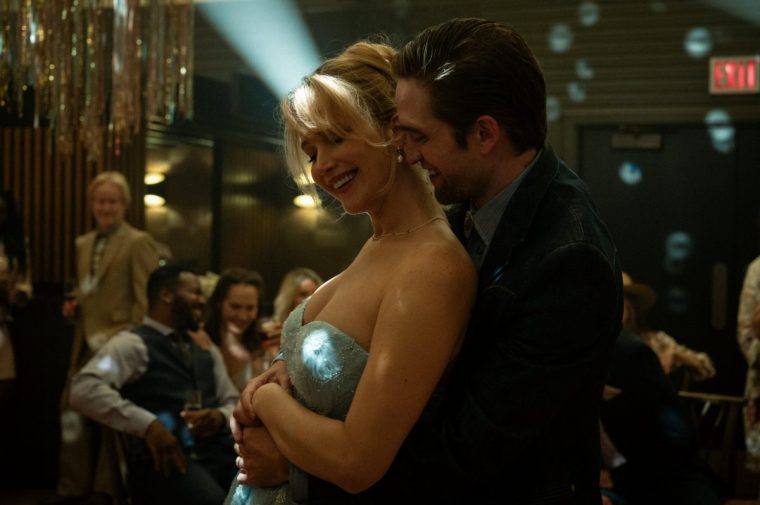
Grace is, frankly, unlikeable, and increasingly prone to behaviour that feels completely insane, like stripping off at a family party and opening the car door travelling at speed. Is she mad? Is she ill? Is she just plain awful? Lawrence brings a weighty intelligence to an otherwise aggravating character and a sense that, inside Grace, this growing turmoil makes sense – which is of course how psychosis presumably does feel.
There’s a sense of inevitability here, too, the film treading that fine line between mental illness and the rationality of finding the upheaval of motherhood unbearable. “I have no problem attaching to my son, he’s perfect,” says Grace. “It’s everything else that’s f***ed.”
This is the fifth feature from Lynne Ramsay (We Need to Talk About Kevin), and is based on the 2012 novella by Ariana Harwicz. It is a more eccentric film about the vagaries of early motherhood than some other recent attempts: more horrifying than 2018’s comedy drama Tully, wilder than the feral but lightweight Nightbitch (2024), it tries to capture the confusion and disappointments of this time by way of an almost folk-horror strangeness.
Ramsay’s We Need to Talk About Kevin (2011) also tackled postnatal depression, of course, but was far more stylised than this film, which is frenetically driven by a kind of maximalist sensory energy, compounded by cinematographer Seamus McGarvey’s expressionist shots panning towering Montana forests and hellish barren kitchens.
In one memorable scene, Grace is trying desperately to write when she sees her breast milk fall onto the page and merge with the ink in a moment that’s as much metaphor as real-life mess. There is no linearity to an experience as visceral and corporeal as this; the past and the present blur, as do reality and fantasy. It’s as close as we’re going to get to being right inside Grace’s head.
Like another soon-to-be-released film about maternal rage, If I Had Legs I’d Kick You starring Rose Byrne, Die My Love doesn’t try to wrap things up neatly. There is something deeply satisfying about a narrative prepared to tackle rage without descending into the cliché that it dissipates as soon as we discuss it. Die My Love is simply too odd to appeal to everyone – but anyone familiar with the despair induced by listening on repeat to “I like to eat apples and bananas”, while wondering where their life, identity and bodily autonomy have gone, will find truth, if not solace, in its singularity.
