Bialowieza, a biodiverse expanse the size of Greater London, is at the heart of a migrant crisis
BIALOWIEZA – On a bracing morning in Bialowieza, Europe’s most ancient forest, on the border between Poland and Belarus, a bulky green truck speeds along a dirt track lined with centuries-old oak and pine trees.
Inside are Polish construction workers headed towards the border a few hundred metres away, on a mission to build a new road to help the authorities deal with a deadly migration crisis.
Bialowieza, a biodiverse expanse the size of Greater London and home to rich wildlife including bison, wolves and lynx, has mostly been untouched for millennia. But the Unesco-protected forest is at the heart of a geopolitical war.
Since 2021, tens of thousands of migrants have tried to enter the European Union, and often the UK, via the so-called “green border” within Bialowieza. It is one of the major migration routes into Europe, along with the Balkans and the Mediterranean.
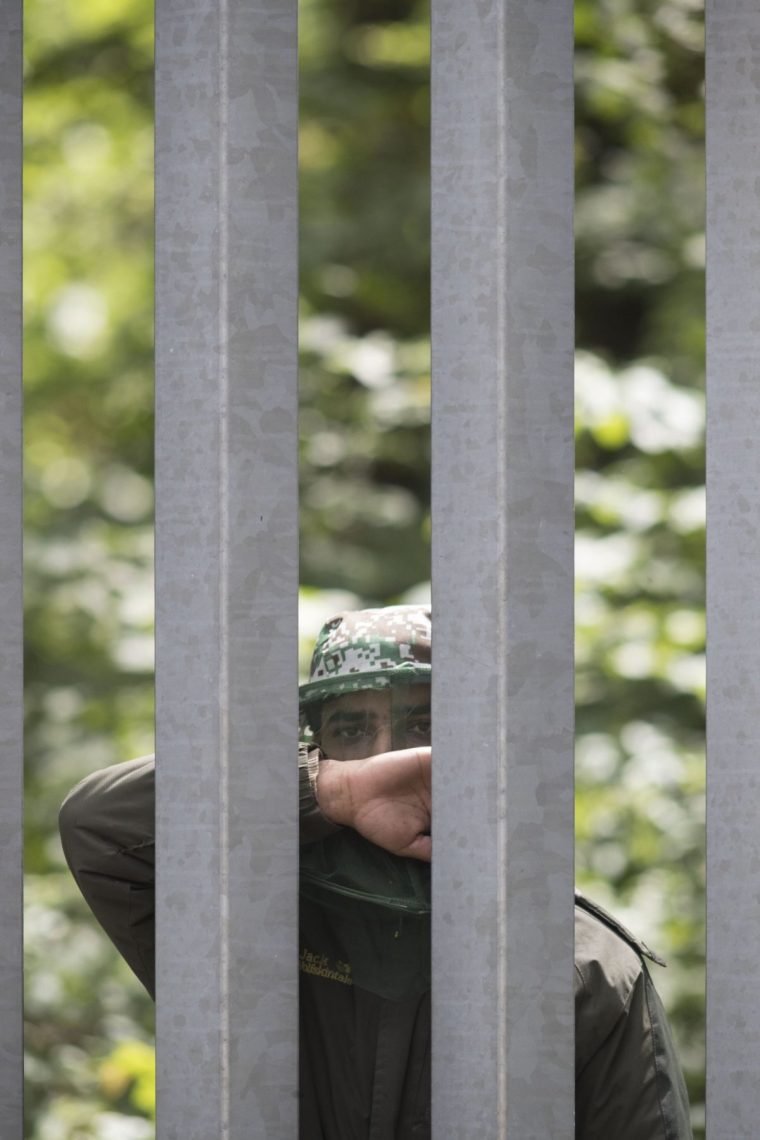
Watching the truck is Aleksandra Chrzanowska, an aid worker providing humanitarian and legal support to migrants at the border. She points to the 186-kilometre, 5.5-metre-high metal fence, equipped with motion sensors and thousands of state-of-the-art thermal imaging cameras.

“It is a high-tech and militarised death trap,” she tells The i Paper. “The wall isn’t stopping people from coming. They’re fleeing war and conflict. It just forces them into more dangerous crossings.”
Migrants climb over, dig under or cut through the wall, which runs almost half the length of the 418 km, Polish-Belarus border, before hiking across the dense forest for hours if not days.
In the Polish capital of Warsaw, 250 km away, a 22-year-old Afghan migrant confirms this. Ahmad (whose name has been changed to protect his identity) told The i Paper he was severely beaten with batons after crossing the wall and then pushed back by border guards before he successfully crossed with the help of smugglers.
“They wouldn’t let me make an asylum claim,” he said. “They didn’t care. Why do they treat us like this?”
Ahmad said he had no choice but to flee the Taliban and his homeland. He said he travelled overland before catching a flight from Iraq to Minsk, the Belarusian capital.
Poland claims Belarus’s autocratic, pro-Russian leader Alexander Lukashenko has orchestrated the migration crisis, encouraging migrants to travel to Belarus and cross over, in retaliation for EU sanctions after his crackdown on pro-democracy protests in 2020.
At first, many migrants came through from Afghanistan and the Middle East, but more than 50 nationalities have now been logged by Polish authorities, including a growing number of people from the Horn of Africa, driven by civil war and famine.
There were about 30,000 attempts to cross the border in 2024, about a third of which were successful, with similar numbers set for 2025.
In response, Poland built its border wall, which is patrolled by thousands of Polish border guards and army soldiers.
Neighbouring Lithuania also constructed a 500 km border wall with Belarus in 2022, and Latvia built a 145 km fence in 2024, with both covering most but not all of the border.
The migrants who do cross are often victims of “brutal” violence at the hands of Belarusian and Polish authorities, leading to serious injuries and death, according to a report last year by Human Rights Watch. It said that Poland is illegally forcing migrants back into Belarus, where they face further abuse, such as rape and torture.
“They are pushed forward and back, like ping pong balls,” said Chrzanowska.
More than 100 migrants, including unaccompanied minors and women, have died at the Polish-Belarusian border since 2021, including by drowning in rivers, hypothermia and apparent murder, according to the Border Deaths Monitoring Group.

Lydia Gall, senior Europe and Central Asia researcher at Human Rights Watch, said the “pushbacks” – common practice across the EU, including by British authorities in Calais stopping small boat crossings – are a violation of international law.
“We’re seeing people with legitimate asylum claims – vulnerable people, elderly and those with chronic diseases – pushed back,” she said.
Katarzyna Poskrobko, a volunteer at the nearest hospital in Hajnówka and a member of the nonprofit Egala, said migrants often arrive with injuries resulting from falls or jumps at the border, including broken legs.
“Border guards wait for them to be discharged and then take them away,” she said.
But while humanitarian groups argue that safe, legal routes should be opened to asylum seekers, the Polish government is focusing its efforts on cracking down on the people smuggling networks profiting from the crisis.
Katarzyna Zdanowicz, a spokesperson for the Border Guard in Podlasie Voivodeship, which includes Bialowieza, said they had arrested 152 traffickers at the border this year. Many smuggle migrants to Germany, France, the Netherlands and the UK, she said.
“We want to break up these criminal gangs,” she added.
Last year, Polish border police collaborated with the UK’s National Crime Agency in a major operation to arrest Iraqi national Hussam Al Ramli, who is alleged to have been a key figure in smuggling networks, at his home in Wolverhampton.
Al Ramli, along with others detained, are alleged to have smuggled at least 750 Syrian migrants via the Polish-Belarus border into the UK, charging each between €4,500 and €12,000.
Polish authorities have also taken legal action in response to what they call the “instrumentalisation” of migration by Belarusian authorities. Zdanowicz said groups of hundreds of migrants try to cross to Poland with help from Belarus, throwing stones and Molotov cocktails at border guards.
On the pushbacks, Zdanowicz denied that anything illegal was being done. “Every day we are attacked,” she said. “We as a border guard are protecting Europe.”
In March, in a move that stunned human rights groups, Poland suspended the right to claim asylum.
Now asylum seekers can only enter Poland via Belarus regularly if they are granted letters of legal support from the European Court of Human Rights. However, these requests can only be lodged once migrants are in Poland, and can take several hours to process, meaning many are pushed back before a response is received.
Poland has also targeted humanitarian groups supporting migrants in Bialowieza, including Chrzanowska’s organisation, claiming they are facilitating people smuggling. In September, five activists were acquitted by a Polish court for providing food, clothing and transport to an Iraqi Kurdistan family of two adults and seven children in distress in March 2022.
“There was no evidence,” said Chrzanowska. “They just want to fatigue us. It’s about repression.”
Back at the border, the sound of vehicles and machinery working to pave over the landscape interrupts the peace of the forest, as what was once a wildlife haven is transformed into a hellscape for desperate people.
