One year to the day of his second presidential victory, a year out from the crucial midterm elections and the morning after his party suffered big losses in the Virginia and New Jersey governor races, President Donald Trump signaled that he has no intention of listening to voters.
Hosting members of the Senate Republican Conference for a breakfast meeting at the White House, Trump took no responsibility for the overwhelming defeat of gubernatorial candidates Winsome Earle-Sears, Jack Ciattarelli or the other GOP candidates on ballots Tuesday.
Instead, he claimed that the “biggest factor” in their defeats was that they weren’t running in a presidential election year and suggested that the landslide losses had been pre-ordained.
“Last night was not expected to be a victory. I don’t think it was good for Republicans. I’m not sure it was good for anybody, but we had an interesting evening, and we learned a lot,” Trump said.
He also suggested that the now record-breaking 36-day government shutdown — the longest in American history — had been a “big factor” that was a “negative for Republicans” and called for Congress to “get the government back open soon, and really immediately.”
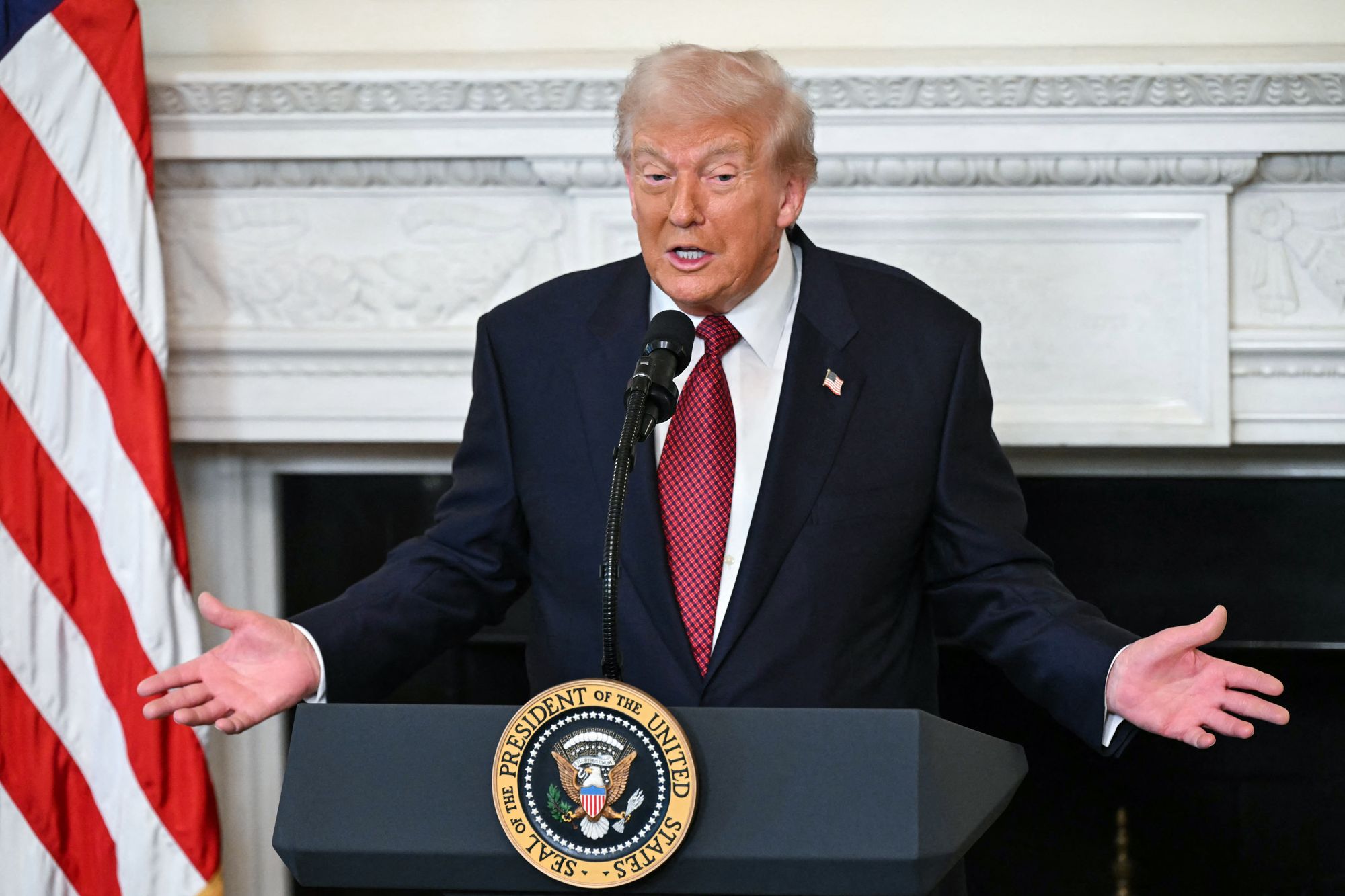
But the president’s concession that keeping hundreds of thousands of federal workers at home on furlough or forcing them to work without pay for more than a month might have been a bad look for Republicans — particularly in Virginia, home to countless civil servants — was not a prelude to a call for the sorts of bipartisan talks that have ended prior funding impasses.
Instead, he offered a solution that indicates absolutely no understanding of what voters were trying to tell him in last night’s election returns. Rather than admit that any problem exists, he exhorted senators to blow up the few remaining levers of power that Democrats currently hold by ending the upper chamber’s 60-vote threshold for most legislation.
“I think it’s very important, we have to get the country up. And the way we’re going to do it this afternoon is to terminate the filibuster,” Trump said.
It’s an idea that’s almost certainly dead-on-arrival with most of the Senate GOP, many of whom have long opposed scrapping the supermajority requirement because it provides a useful check against Democrats when the GOP is out of power and forces senators to compromise when writing legislation that needs broad, bipartisan support to pass.
Majority Leader John Thune, who has served in the upper chamber for two decades, admitted as such earlier this week when he told reporters the so-called “nuclear option” lacks enough support to garner the 51 votes (or 50 with the support of Vice President JD Vance) it would need to change the Senate’s standing rules.
While Trump appeared to concede this point when he told senators it was “possible” that they would not scrap the filibuster and said he’d abide by their wishes, his justification for making the request revealed his lack of comprehension of last night’s results.
Eliminating Democrats’ ability to block legislation by requiring bills to receive 60 votes, he said, would let Republicans use their current unified control of Washington to pass a laundry list of GOP proposals that would lock Democrats out of power for a generation.
“They’ll most likely never attain power, because we will have passed every single thing that you can imagine that is good and all good for the country, and there’ll be no reason [to elect Democrats],” he said.
“If you don’t terminate the filibuster, we won’t pass any legislation.”
For example, he suggested passage of a national voter ID law in response to last night’s California special election in which voters approved a ballot measure to temporarily alter the state’s congressional map in response to Republican gerrymandering in Texas.
“We should pass all the things that we want to make our election is secure and safe, because California is a disaster. Many of the states are disasters,” he said.
What went unsaid is that the legislation Trump wants to the Senate to pass after ditching the filibuster is almost entirely explicitly partisan — and deeply unpopular with the majority of voters who will decide whether to keep unified GOP control of Washington one year hence.
But 10 months into Trump’s second term, it’s clear he either doesn’t understand that the things that routinely get bottled up by the Senate’s supermajority requirement are unpopular — or he doesn’t care, because he’s been told the proposals are popular among his most fervent supporters.
Right now, the MAGA faithful appear to be the only ones who are still all-in on the wholesale gutting and rebuilding of the government — and the country — in his image.
Last night, Democratic candidates in both the Garden State and the Old Dominion carried bellwether counties where he’d made significant inroads just a year earlier by massive margins. The Latino voters and non-college-educated voters who powered his victory over then-vice president Kamala Harris in seven swing states last year swung back towards Sherrill and Spanberger by significant margins.
Even Jason Jones, the embattled Democratic candidate for Virginia Attorney General, trounced his GOP incumbent opponent despite his history of disturbing and violent rhetoric about Republicans in the state legislature — and their children.
It was a clear signal that after ten months of DOGE layoffs, massive tax increases imposed by executive fiat, masked ICE and CBP agents and officers snatching non-white people off the street without warning, the revenge rampage against Trump’s adversaries and the literal demolition of the White House’s East Wing without any meaningful action to address the affordability issues he was elected to address, voters want him to change course.
It’s a message that one of Trump’s predecessors, Barack Obama, understood well.
After his party took what he called a “shellacking” in the 2010 midterm elections, he suggested the reason was that he’d lost touch with voters while enacting an agenda they weren’t fully on board with.
“There is an inherent danger in being in the White House and being in the bubble … sometimes we lose track of the ways that we connected with folks that got us here in the first place,” he said.
Trump’s call to kill the filibuster after last night’s results shows he, like Obama, is trapped in that same “bubble.”
