Wartorn Ukraine is becoming a testing ground for high-tech weaponry making its way into the hands of powerful gangs
Deep in the dusty, arid mountains of Sinaloa, northwest Mexico, lies the tiny village of La Tuna, the humble birthplace of billionaire drug baron Joaquín Guzmán, better-known as El Chapo; once the lynchpin of the powerful Sinaloa Cartel, now rotting in an American supermax prison.
In his absence, things are falling apart. The Sinaloa Cartel is now in a state of civil war between his sons, the Chapitos (“little Chapos”) and another faction loyal to his former business partner, El Mayo.
Recently, footage on social media purportedly showed a drone piloted by the rival Gulf Cartel dropping a bomb on Chapo’s mother’s house in La Tuna.
A source within the Sinaloa Cartel played down the attack. “That event in La Tuna is more gossip than reality,” they told The i Paper. “Nobody is living in that house, and the drone didn’t cause a lot of damage; it crashed into a big tree outside the house.”
It’s not clear precisely when the incident took place, but a recent spate of drone attacks in the area was confirmed by the state governor last week.
On the other side of the globe, on the frontlines of Ukraine, drones (or unmanned aerial vehicles – UAVs) have become an essential part of both Russian and Ukrainian forces’ arsenals, by some estimates inflicting up to 70-80 per cent of all battlefield casualties.
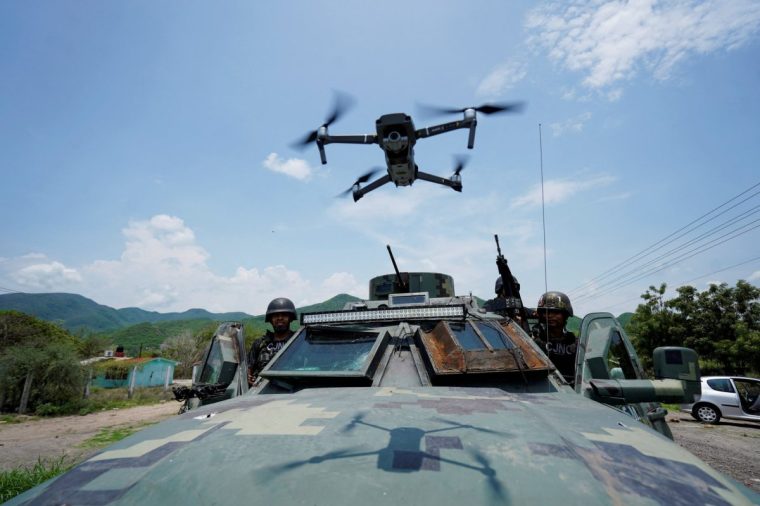
But while drones have been used for criminal activities – for example, delivering contraband into prison – for many years now, experts warn that war-torn Ukraine is becoming a testing ground for high-tech weaponry making its way into the hands of powerful criminal organisations.
“The militaries in many countries are now seriously waking up to how they will employ drone technology,” said Paddy Ginn, an ex-British Army officer and senior expert at the Global Initiative, whose report Crime By Drone was released last week.
“Organised crime is absolutely not behind the curve, and they are utilising the technologies, the expertise and the tactics and techniques that are being seen on the battlefield in Ukraine. And law enforcement has got to work fast to catch up.”
According to Ginn, drones are attractive to criminals because they allow them to quite literally distance themselves from their felonious deeds.
“The barriers to entry of the use of drone capabilities have been lowered so much recently by these technologies being shared online, by 3D printing, by the expertise and skills that have bled out from Ukraine,” he continued.
Drug smugglers have deployed UAVs on the Indian-Pakistani border and the Strait of Gibraltar, ferrying hashish from Morocco to Spain. They can also be used for reconnaissance or surveillance – for example, scouting for police checkpoints – and of course, to attack. Last week, Brazilian gangsters retaliated against a deadly police incursion into Rio de Janeiro’s favelas by dropping explosive payloads on police positions.
“If you think about the expertise, the skill, the coordination required to do that – because this was multiple drones in multiple locations, all at the same time, dropping bombs – it is very, very scary, very worrying,” said Ginn.
In Mexico, drone warfare has been most extensive in the state of Michoacán, where fighting between drug cartels, local gangs, and vigilante militias (some of which are fronts or proxies for organised crime) has left certain areas resembling a classic warzone, with burnt-out cars and empty villages.
Members of the Jalisco New Generation Cartel have emerged as the most prolific quadcopter enthusiasts, their team of specialised drone operators dropping bombs on the heads of their enemies.
According to The i Paper’s source, cartel drone tech still leaves much to be desired.
“The bad guys here are buying a lot of drones,” revealed the Sinaloa Cartel operative.
“Nowadays, the war here is by using drones to attack the enemies’ cars and using [counter-drone jammers] to defend.”
The operative said the drone attacks using explosives were “basic, because their range and efficiency is so low they almost never reach the target”.
But that might soon change because of advances made in Ukraine.
Ginn notes that previously, drones used on the battlefield were “produced simply as methods of reconnaissance, surveillance and attack using standard off-the-shelf products, mostly Chinese variants, that were bought and purchased from commercial suppliers”.
The landscape has now transformed, he added, into “this incredible industry of every single part of the drone as a system being taken apart, analysed, improved, and worked out how to make it even better”.
“Drones that can be used to attack and kill individual soldiers. Drones that can be used to attack and destroy armoured vehicles. Drones that can be used to intercept other drones … all this technological evolution has bled into the internet.”
At the start of the Russian invasion, Ginn’s co-author Alex Goodwin observed, “drones were a stopgap way of helping the Ukrainians readdress their numerical disadvantage compared to the Russians”.
“As time has gone by, the cycle of evolution has been breathtaking,” he added. “The Russians copied many of the Ukrainian innovations, then began their own, such as fibre-optic drones.”
“And of course, criminal organisations who are incredibly well-resourced pick up on this,” Ginn continued. “What they started to do is send people to fight with the Ukrainians – not because they believe in the cause, but that they want them to bring that expertise back to Mexico. Because at its most basic level, drone operations still need effective humans.”
In the summer, an investigation revealed that a number of foreign fighters – including Mexican cartel members, as well as Colombian guerrillas and mercenaries – had enlisted in Ukraine’s International Legion to gain experience flying the death machines.
In Colombia in particular, the number of UAV attacks has surged from 119 in 2024 to 180 in the first eight months of this year alone. Guerrillas and drug cartels use bomb-laden drones to defend their cocaine business.
Ginn says the danger of drones from criminal elements is one that should be taken seriously.
“The law enforcement and policy responses need to seriously consider this, and not treat it as kind of a surprise every time they come up against it,” he said.
“I think the genie is out of the bottle on this one. It’s gonna continue to be a factor in how organised crime groups are operating.”
