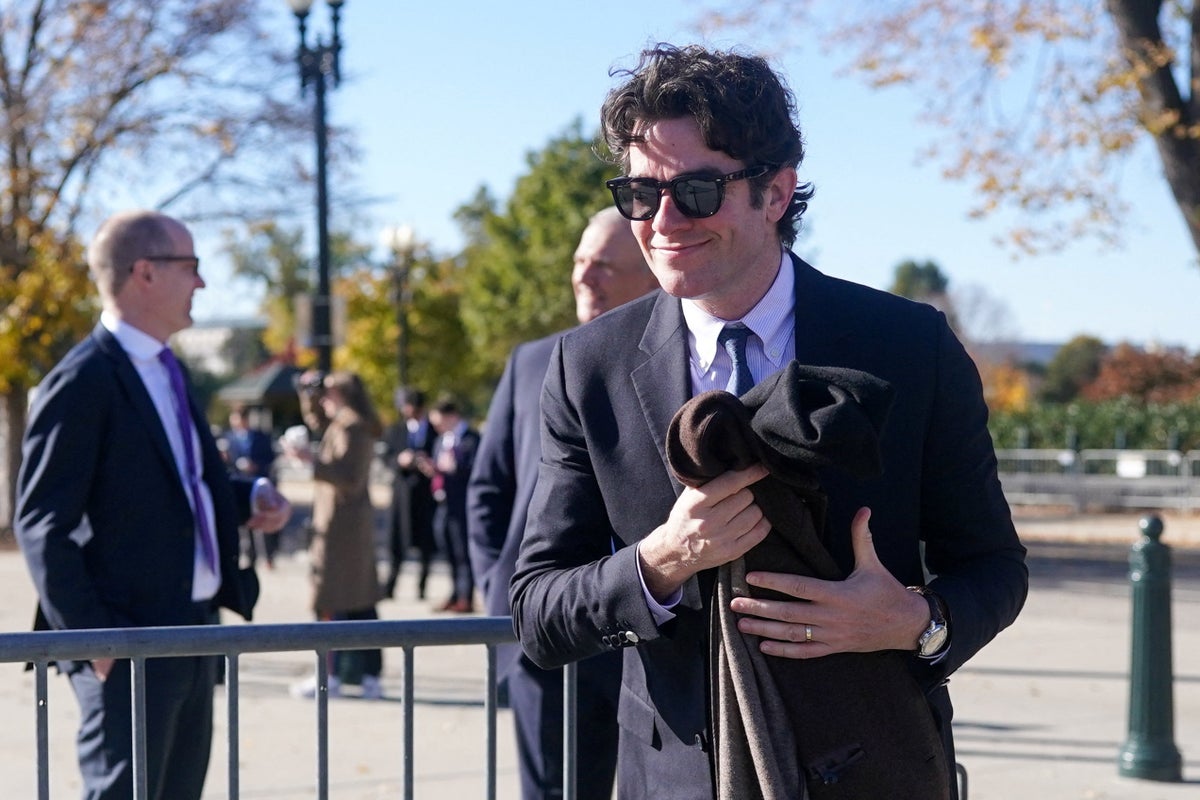
A cast of well-known politicians and Trump administration officials sat in the U.S. Supreme Court courtroom Wednesday morning to hear the high-stakes arguments in the challenge to President Donald Trump’s sweeping tariffs – with one unexpected comedian also in attendance.
Commerce Secretary Howard Lutnick, Treasury Secretary Scott Bessent and Trade Representative Jamieson Greer, three figures deeply ingrained in Trump’s tariff policy, sat and listened as the nine justices drilled Solicitor General D. John Sauer about the administration’s justification for the tariffs.
Democratic Senators Amy Klobuchar and Ed Markey, two lawmakers who have condemned Trump’s tariffs, were also in attendance alongside Republican Senator and Trump ally, Mike Lee.
Then, in the back, sat comedian and actor John Mulaney.
Over the course of nearly three hours, attendees heard arguments between justices, Sauer, who is defending the administration, and Neal Katyal, who is defending a group of small businesses that sued the president for enacting tariffs on nearly every one of the U.S.’s trading partners, causing their overhead costs to skyrocket.
It was not immediately clear why Mulaney, who is not a politician, was in attendance.
The comedian does appear to have a friendly relationship with Katyal. In July 2023, Mulaney appeared on Katayl’s podcast COURSTIDE with Neal Katyal, where the two discussed a landmark court case. In turn, Katyal appeared on Mulaney’s Netflix show Everybody’s Live with John Mulaney in April.
The Independent has asked representatives for Mulaney for comment.
The case, which Trump has described as “LIFE OR DEATH” for the United States, will determine if the president was justified in bringing tariffs under the 1977 International Emergency Economic Powers Act, which permits the president to regulate trade in “unusual and extraordinary” circumstances when a national emergency is declared.
Trump’s “Liberation Day” tariffs, which included a baseline 10 percent tariff on most trading partners plus heavier reciprocal tariffs, were part of a national emergency to make trade deficits more fair and protect national security, the president says.
But even conservative Supreme Court justices appeared skeptical of the strength of that argument.
Chief Justice John Roberts, who has led the court in expanding Trump’s executive authority this year, explicitly stated that tariffs, even when used for foreign affairs, are considered “taxes on Americans,” which has “always been a core power of Congress.”
“Is it your contention that every country needed to be tariffed because of threats to the defense and industrial base?” Justice Amy Coney Barrett, a nominee of Trump’s, questioned. “I mean, Spain? France? I mean, I could see it with some countries, but explain to me why, as many countries, needed to be subject to the reciprocal tariff policy, as are.”
Justice Neil Gorsuch, also a Trump nominee, raised concerns about the administration’s interpretation of the 1977 law and the separation of powers.
He contended that, under Sauer’s argument, it could be “a one-way ratchet toward the gradual but continual accretion of power in the executive branch and away from the people’s elected representatives.”
But the conservative justices were still open to the idea that the president does have some authority under IEEPA to regulate trade.
Justice Brett Kavanaugh pointed out that taking away the power to tariff could remove a “tool” from the president to deal with economic emergencies.
Mulaney’s presence may have inspired some comedic relief throughout the arguments, which, although intense, also contained moments of lightheartedness.
At one point, Kavanaugh questioned why Congress gave the president the power to regulate trade, but not enact tariffs even minimally, referring to it as a “donut hole.”
“It’s not a donut hole but a fundamentally different pastry,” the solicitor general from Oregon responded, drawing laughter from the room.
It’s unclear when the Supreme Court will rule in the case; they could decide as early as next week or as late as June. The stakes of the case are high; if the court rules against the tariffs, even narrowly, it could cause major economic disruption – a point that Sauer highlighted.
