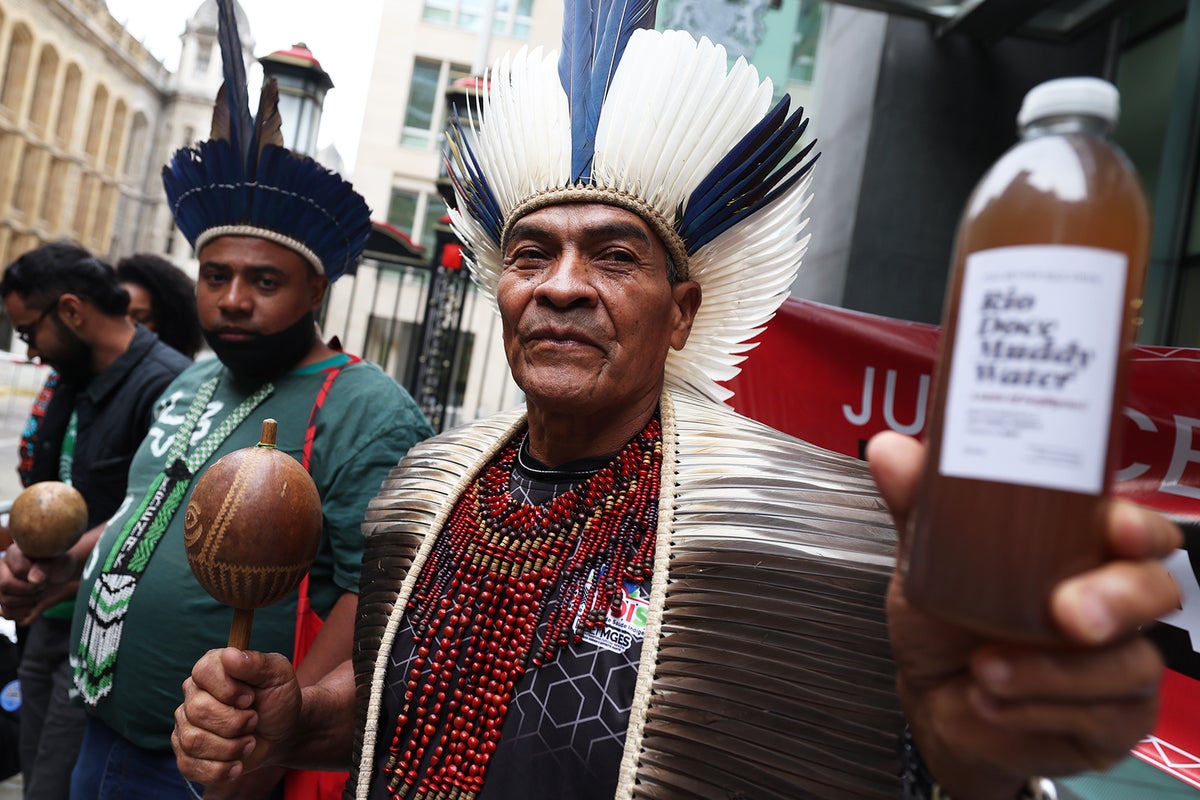
When Brazil’s Mariana dam collapsed on 5 November 2015, Alinne Ribeiro’s husband was swept away in a cascade of mud and water.
It was an environmental catastrophe which caused untold devastation in the southeast Brazilian mountains, killing 19 people, and unleashing disastrous long-term consequences on thousands who live in the peaceful mountain villages of the Minas Gerais state.
A decade later, Anglo-British mining giant BHP awaits judgement in the UK High Court over its responsibility for the collapse, in a £36 billion claim brought by 620,000 people – in what is said to be Britain’s largest ever class action.
“They could have avoided it. They didn’t care who was under the dam. Everyone that was there, everyone that died there, had dreams and they were innocent,” said Ms Ribeiro.
“This trauma will stay with us forever and ever,” she continued. “They took from us a dream for our entire life. I’ll never forgive BHP, because they knew that they would kill those people, and they simply turned away.”
Ten years of legal wrangling have left the hopes of hundreds of thousands of Brazilians for long-awaited justice resting on a London court 9,000 kilometres away from home, with a final decision expected in November or December after more than half a year of deliberation.
The iron ore tailings dam collapsed at 4:20pm, 44.5 million cubic metres of toxic sludge cascaded through the hills of Minas Gerais state, with pollutants recorded as far as 668 kilometres (451 miles) away from the dam.
Villages were flattened and indigenous communities saw their way of life destroyed following heavy damage to the Doce River, a critical source of irrigation, water, food and leisure for groups such as the Krenak.
Arguments in the trial, which began in October 2024, partly rested on whether BHP can be held culpable for the failures of Samarco – a joint venture in which it held a 50 per cent stake – to address the compromised stability of the dam.
BHP says the claimants argument “rests on incorrectly eliding the distinctions between BHP, BHP Brazil and Samarco”, but the claimants argue that the giant had significant involvement in, and exercised influence over, Samarco’s activities.
Pogust Goodhead, the UK law firm representing the claimants, said an October filing by BHP marked the first time the firm had accepted key aspects regarding the extensive damage caused by the collapse, including the destruction of villages and increases in toxic metals in the rivers. The BHP filing does not accept culpability for these impacts.
Claimants and lawyers hope the court’s decision will bring closure for the victims of the dam collapse, who have struggled to move on from their lives while they do not feel that those responsible for the dam collapse have faced the necessary consequences.
“Every time that we get near to the date of the damn rapture,” Ms Ribeiro said of the 10 year anniversary, “the feeling is of profound sadness”.
“It was like we are leaving this all over again like we’re griefing all over again. They were taken from us. They didn’t just go out of home and leave. They left home to work, or to do something. They were taken from us. I’m talking about children, about sons that didn’t come back, husbands that didn’t come back. Our children don’t have their fathers anymore.”
One of those children is Ms Ribeiro’s own 12-year-old daughter, who was two at the time of her father’s death.
“She will carry this trauma for the rest of her life,” she said. “She says that she has friends that have fathers, but she doesn’t have a father. She doesn’t have someone to write a letter to for Father’s Day.”
Alicia Alinia, CEO at Pogust Goodhead, said the collapse of the dam was “not an accident” and it “continues to devastate lives, communities, and ecosystems a decade later”.
“It is unacceptable that so many victims are still fighting for the justice and compensation they deserve.
“As lawyers, our mission is first and foremost to secure justice and fair compensation for our clients. But judgments that hold powerful corporations to account can achieve far more – they can drive systemic change, shaping how companies act, how boards make decisions, and how investors demand responsibility.”
“A positive ruling against BHP would send a powerful message to corporations worldwide: profit can never come at the expense of human life or the environment.”
A spokesperson for BHP said the dam failure was a “terrible tragedy” in a statement.
“As a shareholder in the Samarco non-operated joint venture, BHP Brasil has always been committed to supporting Samarco on the extensive reparation and compensation efforts in Brazil.
“Samarco, BHP Brasil and Vale continue to implement the agreement reached with the Brazilian public authorities in October 2024 which provides R$170 billion (US$31.7 billion) in total remediation and compensation programmes in Brazil.
“Since 2015, approximately US$12.6 billion has been spent on reparation, compensation and payments directly to affected people and to Public Authorities in Brazil.BHP remains confident that the measures taken in Brazil are the most efficient and effective way to provide full and fair remediation to those impacted.”
