Donald Trump has suggested he could tell Israel to release the one man who could unify the Palestinians from prison in Israel where he has spent more than two decades
US President Donald Trump has declared that he may push for the release of the “Palestinian Nelson Mandela” – the most famous prisoner being held in Israel – in a tacit, if surprising, acknowledgement that he could be the only leader capable of unifying his people.
Marwan Barghouti is only in prison in Israel because he is a “symbol” who can unite the Palestinians, a former top Israeli diplomat told The i Paper, adding that Trump and Europe both had roles to play in pressing for his release.
Trump is considering putting pressure on Israel to free Barghouti, far and away the most popular Palestinian politician, who is serving multiple life sentences in prison, having been convicted in 2004 for planning attacks that led to five civilians being killed in Israel.
Barghouti, 66, a long-standing leader in the secular Fatah party which has long favoured a two-state solution, has always rejected the charges against him. He was not included in the prisoner-hostage exchanges as part of this month’s Gaza ceasefire deal, after Benjamin Netanyahu, the Israeli prime minister, refused Hamas‘ requests for his release.
Trump was asked by Time Magazine if he would back releasing Barghouti as a potentially unifying leader. The US President said: “That was my question of the day. So I’ll be making a decision,” adding: “They don’t have a leader right now. At least a visible leader.”
Barghouti’s wife, Fadwa, appealed to Trump to help release her husband “for the sake of freedom for the Palestinian people”. She said: “Mr President, a genuine partner awaits you — one who can help fulfil the dream we share of a just and lasting peace in the region.”

Barghouti, a fluent Hebrew speaker who has a master’s degree in international relations from Bir Zeit University in the West Bank, consistently tops polls among Palestinians — both in Gaza and the West Bank — as favourite to succeed the unpopular 89-year-old Mahmoud Abbas as Palestinian Authority president.
Some Palestinians view him as their own Nelson Mandela, the South African anti-apartheid activist who became his country’s first black leader.
It is not lost even on some in Israel that he could be the man to deliver a peace agreement if and when Israel is ready for one.
‘Barghouti is in prison because he is a symbol’
Alon Liel, former director general of Israel’s foreign ministry, first met Barghouti over a quarter of a century ago, met him frequently during the 1990s, and has long called for his release.
Liel said of his talks with Barghouti during that time: “The relations were very, very close and intimate. And we had lots of conversations, and we spoke only about one issue, about peace, about two states, about withdrawal [by Israel from the occupied territories].”
He points out that in the prisoner-hostages exchange, 250 prisoners convicted of violent attacks on Israelis – many with more concurrent life sentences than Barghouti — were freed, including many in Hamas.
Liel told The i Paper: “The only reason we kept [Barghouti] in jail is that he is a political leader. He is a symbol… and he can probably unite the Palestinian people behind him. So the only reason we didn’t release him is that we don’t want to talk with the Palestinians. We prefer the guy who can lead them to be in jail.”
Liel points out that even when he spoke with Barghouti after the start of the Second Intifada in 2000, following the failed Camp David talks, Barghouti insisted the conflict could be halted by withdrawal from the occupied Palestinian territories.
In contrast to Hamas, which is frequently condemned for ultimately seeking a Palestinian state “from the river to the sea” — i.e. subsuming Israel itself —Barghouti, like his Fatah colleagues, has consistently sought a solution in which the Palestinian state would be confined to the territories seized by Israel in 1967: the West Bank, East Jerusalem and Gaza.
For Liel, the comparison with Mandela is not misplaced. A former ambassador to South Africa under prime minister Ehud Barak, he is probably the only Israeli who knew both men well. Both men were “charismatic” and both became accepted in jail as the leader of their imprisoned fellow countrymen. Both were labelled as terrorists but both were committed to ending conflict if they could.
‘We are afraid he will be killed in prison’
Those who have campaigned for Barghouti’s release point to report for the Inter-parliamentary Union by the international lawyer Simon Foreman, which held that it was “impossible to conclude that Mr Barghouti was given a fair trial”.
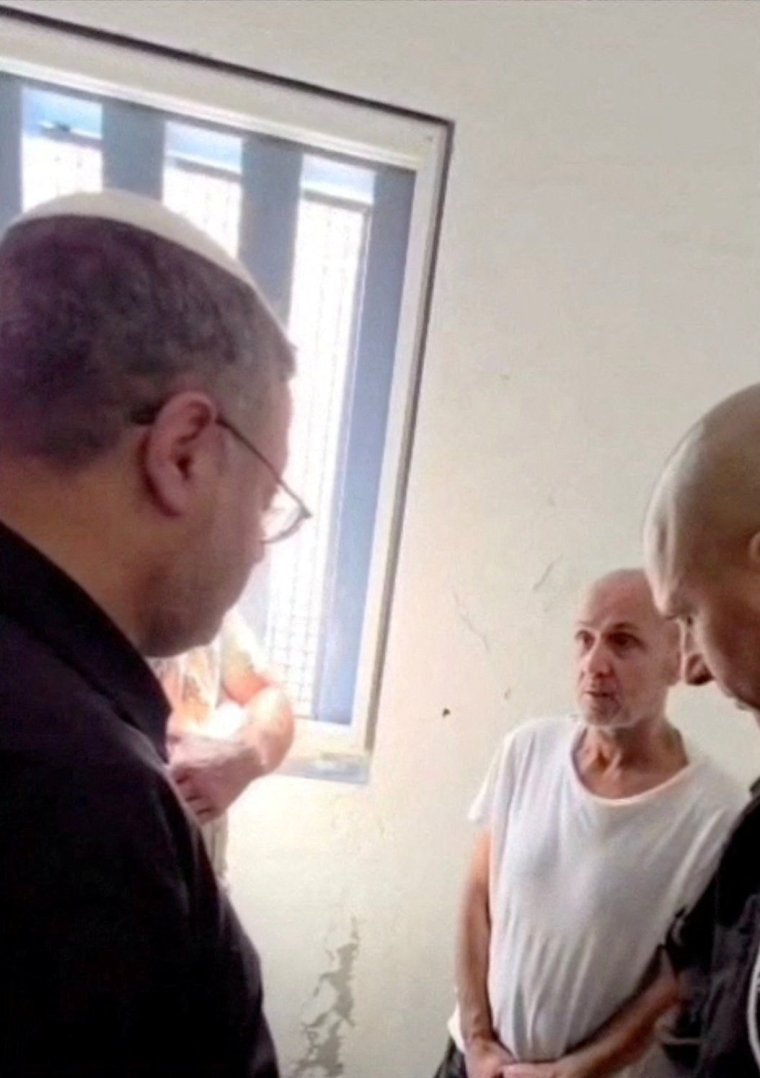
Barghouti’s family say he has been increasingly mistreated in prison, culminating in the testimony of five now released prisoners held with Barghouti that he was beaten unconscious by eight prison guards in September.
His son, Arab Barghouti, said: “I call on the world to please speak out on what is happening to Marwan Barghouti. They are trying to assassinate him in prison, and nothing is going to stop them except for pressure from the international community.”
Itamar Ben Gvir, Netanyahu’s extremist national security minister, who was videoed personally taunting Barghouti during a visit to his cell, dismissed the testimony while nevertheless declaring that he was “proud” that Barghouti’s situation “has changed radically during my tenure – play time is over”.
Whether or not the unpredictable Trump follows through on his remarks on Thursday, Liel believes it is not only up to the US.
“The Europeans during the war played a very important role in bringing us to this ceasefire through the recognitions of Palestine,” he said. “Now we are in a different stage, hopefully, and now we have to think of moving forward. And in order to move forward, you need Barghouti and I hope voices will start being heard in Europe for his release.
“If the world will stabilise the situation in Gaza, we’ll start thinking about talks again. This is the guy who can make the difference.”
