A new arms race is emerging after decades of reductions in nuclear stockpiles since the Cold War
The world’s nuclear-armed states are beefing up their atomic arsenals and walking out of arms control pacts, a think tank has said.
A new arms race is emerging after decades of reductions in the stockpiles since the Cold War, according to the Stockholm International Peace Research Institute (SIPRI).
It comes amid escalating tensions between Israel, one of the world’s nuclear powers, and Iran.
Israel said it bombed Iran over the past week to stop it from being able to produce nuclear weapons.
Here, The i Paper takes a look at the countries with nuclear weapons and how dangerous they are.
Which countries have nuclear weapons?
There are nine nuclear states: the United States, Russia, the United Kingdom, France, China, India, Pakistan, North Korea and Israel.
SIPRI said global tensions have led to the nine states planning to increase their stockpiles.
“The era of reductions in the number of nuclear weapons in the world, which had lasted since the end of the Cold War, is coming to an end,” SIPRI said in its annual inventory of the world’s most dangerous weapons.
“Instead, we see a clear trend of growing nuclear arsenals, sharpened nuclear rhetoric and the abandonment of arms control agreements.”
Of the total global inventory of an estimated 12,241 warheads in January 2025, about 9,614 were in military stockpiles for potential use.
Around 2,100 of the deployed warheads were kept in a state of high operational art of ballistic missiles, nearly all belonging to either the US or Russia.
Russia and the US, which together possess around 90 per cent of all nuclear weapons, are implementing extensive modernisation programmes that could increase the size of their arsenals in the future.
Both had kept the sizes of their respective usable warheads relatively stable in 2024.
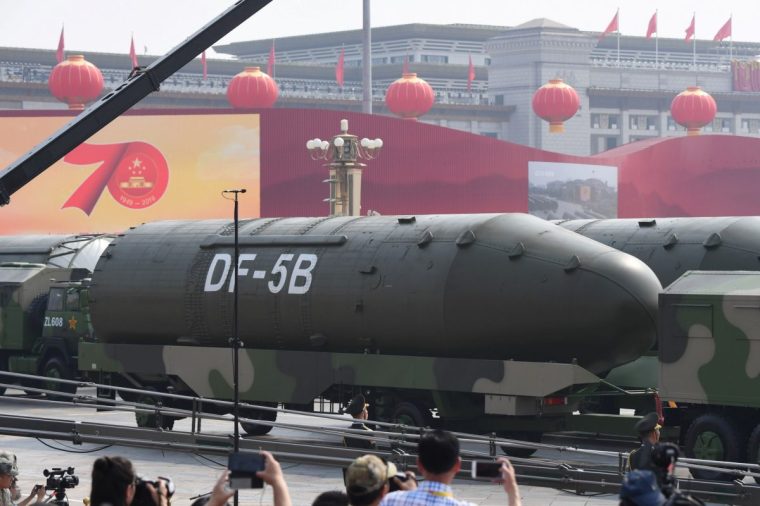
China has the fastest-growing arsenal. Beijing has added about 100 new warheads per year since 2023.
By the turn of the decade, China could potentially have at least as many intercontinental ballistic missiles as either Russia or the US.
Russia and the US hold around 5,459 and 5,177 nuclear warheads, respectively, while China has around 600, according to SIPRI estimates.
How dangerous is this arms race?
Dan Smith, SIPRI director, said: “The signs are that a new arms race is gearing up that carries much more risk and uncertainty than the last one.”
SIPRI warned that “revitalised national debates in East Asia, Europe and the Middle East about nuclear status and strategy suggest there is some potential for more states to develop their own nuclear weapons”.
Robert Kelly, a professor specialising in nuclear proliferation at South Korea’s Pusan National University, told NBC News that countries like Iran, which was just bombed by Israel, may be increasingly tempted to get nuclear weapons to protect themselves from attacks.
He fears that Israel’s attacks on Iran will trigger proliferation both “horizontal” — nuclear states building more weapons — and “vertical” — non-nuclear states trying to get them.
The nuclear countries that most concern the UK are Russia and China.
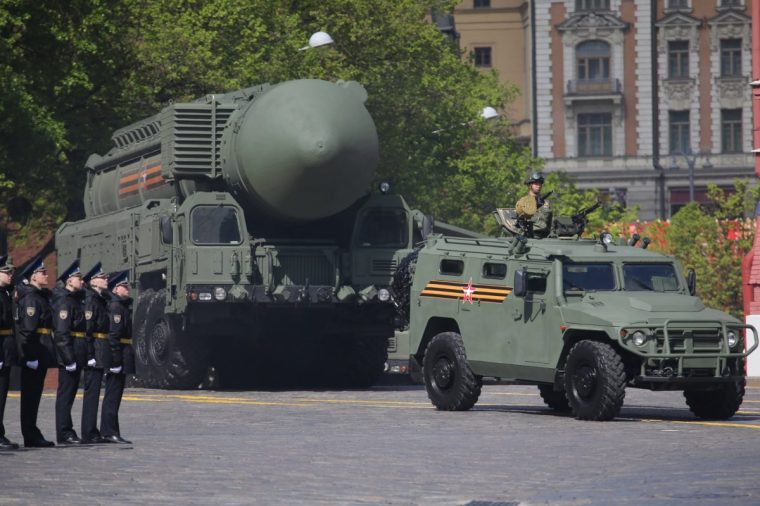
The UK Government described Russia as an “immediate and pressing threat” in the recent Strategic Defence Review, and sees China as “a sophisticated and persistent challenge”.
Luke de Pulford of the Inter-Parliamentary Alliance on China said: “Against a background of ever-increasing grey zone activity around Taiwan and escalating aggression in the South and West Pacific and West Philippine Sea, we should all be deeply troubled by China’s expanding nuclear arsenal.”
Last month, US Secretary of Defence Pete Hegseth warned invasion of Taiwan by China could in fact be imminent.
China has a policy of “no first use” of nukes, which means they would only be used for self-defence.
But Lukasz Kulesa, director of proliferation and nuclear policy at RUSI, said the increased nuclear arsenal will “create options” for China’s leadership.
Who has the most nuclear weapons?
All of the nuclear states are either deploying or developing new weapon systems or have announced their intention to do so, according to SIPRI.
Russia, China, India, Pakistan and North Korea deploy missiles capable of carrying nuclear weapons and are believed to be modernising their capabilities.
Russia has the highest number of deployed nuclear warheads after the US, at 1,718. This is just shy of the US’s 1,770.
Deployed warheads are warheads placed on missiles or located on bases with operational forces.
China has 24 deployed warheads, and North Korea has none. Russia has the highest total number of nuclear warheads stockpiled, at 4,309 – including 2,591 in storage.
Stored warheads would require some preparation, such as the installation of components, transport or loading onto launchers, before they could be used.
This compares with the US’s total of 3,700, of which 1,930 are stored.
China has 576 in storage, for a total of 600 including those deployed.
At the current rate of increase, China could have 1,500 nuclear warheads by 2035.
North Korea has a total of 50 warheads in its military stockpile, all of which are stored.
Both Russia and the US also have more than 1,000 warheads that have been retired from the military stockpiles but have yet to be dismantled.
How dangerous are their weapons?
In 2022, Russia said it deploys 1,549 strategic warheads on 540 strategic delivery systems: intercontinental ballistic missiles, submarine-launched ballistic missiles, and heavy bombers, according to the Arms Control Association.
Nuclear weapons are typically divided into two categories: strategic weapons — longer-range missiles that can cross oceans and threaten rival superpowers — and tactical weapons, which have a more limited capacity.
Russia holds the record for the most powerful nuclear weapon ever exploded. In 1961, it tested a bomb of at least 50 megatons, nicknamed “Tsar Bomba” – or ruler of bombs.
The American bombs that were dropped on Hiroshima and Nagasaki and killed thousands during World War Two had yields of 15 and 21 kilotons.
The power of a nuclear weapon is measured by its yield as a TNT equivalent.
Even the least-powerful nuclear bomb — with a yield of about 0.3 kilotons — has about the same explosive power as the 2020 Beirut port explosion.
Although China keeps the details of its nuclear arsenal mostly secret, the country is known to have intercontinental ballistic missiles, submarine-launched ballistic missiles and bombers.
Earlier this month China released details of its DF-5B nuclear missile, a 7,500-mile-range weapon.
The weapon is 200 times more powerful than the bombs used at Hiroshima and Nagasaki and is said to deliver a yield of three to four megatons.
In 2017, North Korea tested a nuclear bomb with a yield of between 100 and 370 kilotons – six times more powerful than the one dropped at Hiroshima.
This is believed to be the last time it tested a nuclear weapon.
